Dentistry is already the specialty that makes patients nervous. They come in anxious, they sit in a chair that tilts back, and they let someone work inside their mouth with metal instruments. The last thing they need to notice, while they’re already on edge, is a cleaning detail that makes them question whether the space is properly sanitized.
And they do notice. Patients are paying close attention in dental offices in a way they don’t in other professional settings. They’re looking at the ceiling while they wait. They’re glancing at the equipment. They’re forming very specific opinions about cleanliness that go directly to their confidence in your practice. A dental office cleaning company that understands this dynamic cleans differently than one that treats a dental office like any other commercial space.
The Standard in a Dental Office Is Not Negotiable
Most commercial cleaning companies do a passable job in office environments. But dental offices aren’t standard commercial environments — they’re healthcare settings. The cleaning protocols required in a dental practice have to account for blood-borne pathogen exposure, aerosol contamination from dental procedures, instrument processing areas, and surfaces that require clinical-grade disinfection.
This isn’t overkill. It’s OSHA compliance. Dental offices are subject to bloodborne pathogen standards that require specific disinfection procedures, specific product categories, and documented processes that can survive an inspection. A cleaning company that doesn’t understand these requirements can leave your practice in violation — and more importantly, can leave your patients at risk.
The right dental office cleaning company knows the difference between a disinfectant and a sanitizer, understands EPA-registered products required for healthcare settings, and applies them correctly to the right surfaces with the right dwell times. That knowledge is the whole point.
What Proper Dental Office Cleaning Covers
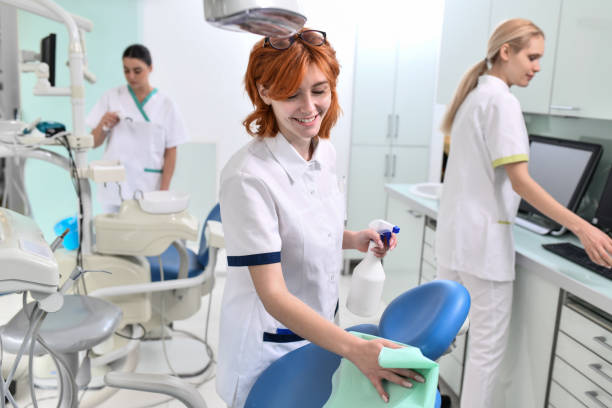
Clinical areas in a dental office require a level of attention that goes well beyond what standard commercial cleaning covers. Treatment room surfaces — chairs, overhead lights, instrument trays, countertops, drawer handles — need to be disinfected with EPA-registered products after every patient and thoroughly cleaned on a daily and weekly schedule.
Waiting rooms need consistent attention too, though for different reasons. These are spaces where sick patients and healthy patients share the same chairs, the same magazines, and the same door handles. Regular disinfection of high-touch surfaces in the waiting area is a real infection control measure, not just a cosmetic one.
Restrooms in dental offices see heavy use from patients who are sometimes anxious and not at their best. They need to be cleaned and restocked frequently, maintained to a clinical standard, and checked throughout the day rather than just once in the morning.
Reception areas, front desk surfaces, payment terminals, and check-in interfaces are all high-touch zones that require regular disinfection. The staff working in these areas interact with every patient who comes in — so surfaces in this zone spread contamination efficiently if not properly managed.
Evening Cleaning After the Last Patient
The most practical time to clean a dental office thoroughly is after the last appointment of the day, when every treatment room is vacant and staff have completed their instrument processing. This window allows cleaners to work through every surface without interrupting patient care or requiring staff to work around them.
A professional dental office cleaning company builds their schedule around this window. They come in after close, work systematically through treatment rooms, common areas, restrooms, and staff spaces, and leave the practice ready for the first patient the next morning. No shortcuts, no areas skipped because someone was still working nearby.
Trust Matters When It’s a Healthcare Setting
The people cleaning a dental office have access to clinical areas, instrument processing zones, and storage spaces that contain controlled substances in some practices. They’re working in a healthcare environment where the stakes of a mistake are higher than they are in a standard office. Trust is not optional — it’s a requirement.
That means background-checked staff, proper training on healthcare cleaning protocols, full insurance coverage, and an accountability structure that ensures the work is actually being done correctly. A cleaning company that can’t demonstrate all of these things isn’t the right fit for a dental practice, regardless of their price.
For dental practices that need a cleaning partner who truly understands healthcare environments, PBC Cleaning brings the training, the protocols, and the accountability that the dental office cleaning company your practice deserves should always provide.